SPACE: Finding a Home with P2W
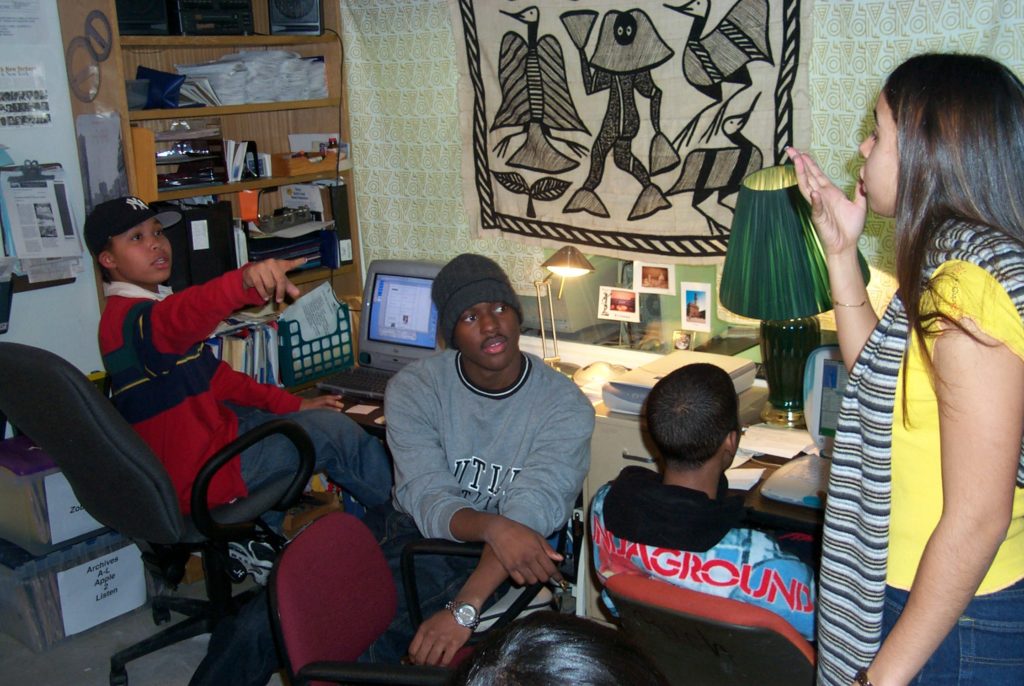
The move to Playing2Win’s East Harlem storefront was more than just a change of scenery for HarlemLIVE. This move meant exposure, immediacy, and a new level of dynamism. Where once we were hidden in a room in Teachers College, we were now front and center — a beacon of youthful energy and creativity. The atmosphere was electric; a hum of ideas being formed, stories being crafted, and young minds being shaped.
HarlemLIVE and P2W’s synergy was evident, a bond further solidified with the entrance of Mara Rose, fresh off her graduation from Teachers College. Her arrival marked a period characterized by mutual growth and collaboration. Mara recalls her initial encounter with the program and its infectious dynamism. She was met with challenges, but these challenges led to the forging of a partnership that thrived on shared values and mutual respect.
After graduating from Teachers College at Columbia University, I took on the role of reviving Playing2Win (P2W) under Boys Harbor, a nonprofit. P2W, located in a Harlem storefront, was in disrepair. Simultaneously, we integrated HarlemLIVE into P2W, creating a vibrant center. HarlemLIVE introduced an unconventional, student-centric approach, fostering individual talents, empowering leadership, and breaking traditional educational constraints. Collaboration between P2W and HarlemLIVE enabled mutual learning, with HarlemLIVE’s commitment to students driving innovative changes.
Tameeka Mitchem reflects: “HarlemLIVE opened me up socially. … It made me more aware of my ability to go out and get the things I want.”

Ena with actress, activist, writer Ruby Dee
And Ena Johnson, who encountered HarlemLIVE as a novice high schooler, adds: “HarlemLIVE had a tremendous impact on my life outlook and journey to self-actualization… This built in me a confidence I carried into adulthood.”
In this video, witnessed Stanley Antoine finishing up his very first attempt at doing a person-on-the-street interview.
Staying Connected: Choosing the Right Digital Communication Platform

 Key Considerations for Choosing a Platform:
I am text block. Click edit button to change this text. Lorem ipsum dolor sit amet, consectetur adipiscing elit. Ut elit tellus, luctus nec ullamcorper mattis, pulvinar dapibus leo.
Student Voices: Growth and Transformation
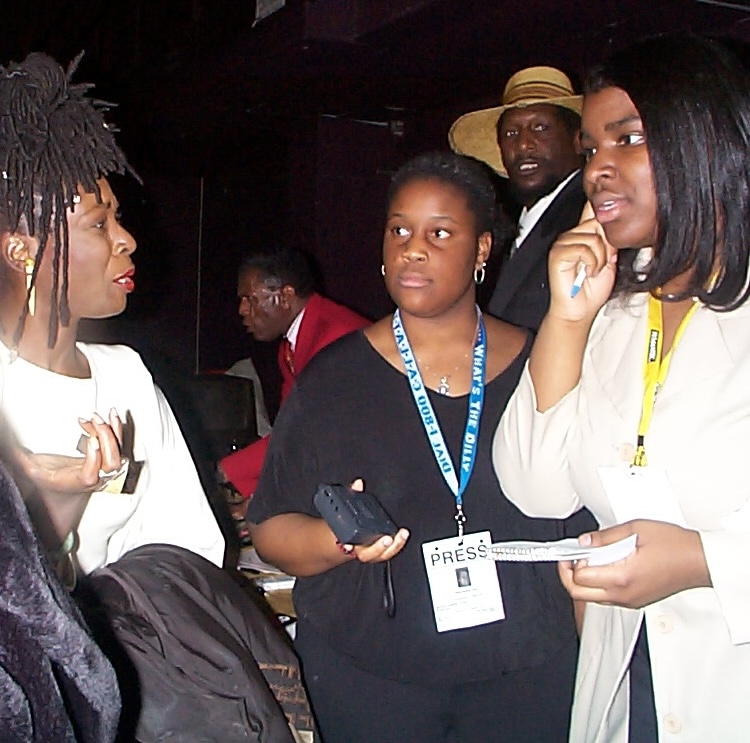
Tameeka Mitchem reflects: “HarlemLIVE opened me up socially. … It made me more aware of my ability to go out and get the things I want.”
Ena with actress, activist, writer Ruby Dee
And Ena Johnson, who encountered HarlemLIVE as a novice high schooler, adds: “HarlemLIVE had a tremendous impact on my life outlook and journey to self-actualization… This built in me a confidence I carried into adulthood.”
In this video, witnessed Stanley Antoine finishing up his very first attempt at doing a person-on-the-street interview.
Staying Connected: Choosing the Right Digital Communication Platform
I am text block. Click edit button to change this text. Lorem ipsum dolor sit amet, consectetur adipiscing elit. Ut elit tellus, luctus nec ullamcorper mattis, pulvinar dapibus leo.
When Going on a Story:
- Is Story Ticket (Sheet) Filled Out?
- Event Posted on HL online Calendar?
- Press Badges? (yours and others)
- HL Fliers
- Name of Org/Place/Event + Contact Person
- Information about …. (research)
- Address and Phone #s
- Cameras (check CHIPS and BATTERIES)
- Notepads and Pens
- Transportation Card and Sheet or Fare
- Tape Recorder (optional) / Walkie Talkies (*)
- Camera / Base / Tripod (optional)
- Batteries
- Headphones
- Microphone (wireless transmitters/receivers)
- Tapes – LABEL THEM!!
Returning from a story:
-
- Put pens, pads (take your notes out and put in your folder), badges and equipment away
- Debrief
- Download pics – LABEL CORRECTLY
- Type out notes / Write Reflections
- Recharge Batteries
- Put transportation card back
[/vc_column_text]
Empowerment Through Press Badges at HarlemLIVE
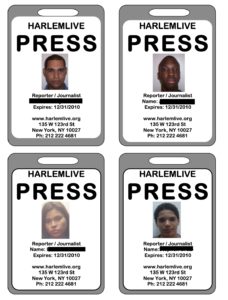 At HarlemLIVE, the press badges were a vital tool for empowerment and learning, especially for newcomers. These badges, printed four to an 8½” x 11″ card stock, were laminated for durability and separated, each with a hole punched at the top for a chain or colored lanyard. When worn around the neck, they signaled a professional approach and intention.
These badges served as more than just identification; they were symbols of trust and credibility. They informed interviewees that conversations were intended for publication, backed by the First Amendment rights of the U.S. Constitution. This aspect was crucial in opening doors to new opportunities and experiences for the students.
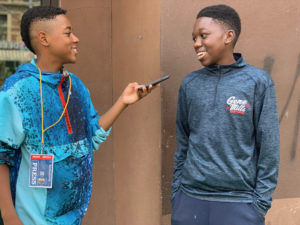 The badges granted access to spaces and individuals that might have been out of reach otherwise, playing a key role in the students’ journalistic empowerment. Through these badges, students interviewed influential figures and covered significant events, like celebrity appearances and critical community incidents, with newfound confidence and authority.
In essence, these press badges were not just pieces of plastic and lamination; they represented a transformation in the students’ lives, providing them with the tools and confidence to explore and report on their world.
The Heartbeat of Harlem: Pulse of the People
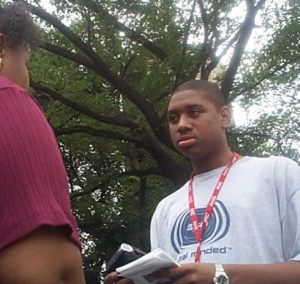
The hustle and bustle of Central Park became a regular backdrop for HarlemLIVE’s “Pulse of the People” (POP) interviews. More than just a reporting exercise, these street interviews became a transformative rite of passage for many of our students. From rookies learning the ropes to seasoned members guiding the way, the collaborative spirit of HarlemLIVE shone brightly during these excursions.
The First Taste of Journalism
Walking up to strangers and initiating conversations wasn’t everyone’s cup of tea, but it was an essential HarlemLIVE experience. With minimal training, we’d push our new members straight into the deep end. Yet, it wasn’t about throwing them under the bus; it was about teaching them to swim, to find their voice, and to shine.
Rite of Passage
The first POP interview was more than just an assignment; it was a transformative moment. The process was direct: “What news topics pique your interest?” After a newbie’s response, we’d transition to role-playing. How to initiate an interview, handle challenging respondents, and ensure the essence of the message was captured were all part of the drill. If the prospect of approaching strangers was too daunting for some, they’d start as photographers, capturing the essence of HarlemLIVE’s fieldwork through their lenses. HarlemLIVE was not just about journalism; it was about empowerment. It was about making sure each student knew their voice had value and teaching them to express themselves fearlessly. (See Creating Youth Journalists for more detailed instructions).
Student Voices: Growth and Transformation
Tameeka Mitchem reflects: “HarlemLIVE opened me up socially. … It made me more aware of my ability to go out and get the things I want.”
Ena with actress, activist, writer Ruby Dee
And Ena Johnson, who encountered HarlemLIVE as a novice high schooler, adds: “HarlemLIVE had a tremendous impact on my life outlook and journey to self-actualization… This built in me a confidence I carried into adulthood.”
In this video, witnessed Stanley Antoine finishing up his very first attempt at doing a person-on-the-street interview.
Staying Connected: Choosing the Right Digital Communication Platform
I am text block. Click edit button to change this text. Lorem ipsum dolor sit amet, consectetur adipiscing elit. Ut elit tellus, luctus nec ullamcorper mattis, pulvinar dapibus leo.
When Going on a Story:
- Is Story Ticket (Sheet) Filled Out?
- Event Posted on HL online Calendar?
- Press Badges? (yours and others)
- HL Fliers
- Name of Org/Place/Event + Contact Person
- Information about …. (research)
- Address and Phone #s
- Cameras (check CHIPS and BATTERIES)
- Notepads and Pens
- Transportation Card and Sheet or Fare
- Tape Recorder (optional) / Walkie Talkies (*)
- Camera / Base / Tripod (optional)
- Batteries
- Headphones
- Microphone (wireless transmitters/receivers)
- Tapes – LABEL THEM!!
Returning from a story:
-
- Put pens, pads (take your notes out and put in your folder), badges and equipment away
- Debrief
- Download pics – LABEL CORRECTLY
- Type out notes / Write Reflections
- Recharge Batteries
- Put transportation card back
[/vc_column_text]
Empowerment Through Press Badges at HarlemLIVE
At HarlemLIVE, the press badges were a vital tool for empowerment and learning, especially for newcomers. These badges, printed four to an 8½” x 11″ card stock, were laminated for durability and separated, each with a hole punched at the top for a chain or colored lanyard. When worn around the neck, they signaled a professional approach and intention.
These badges served as more than just identification; they were symbols of trust and credibility. They informed interviewees that conversations were intended for publication, backed by the First Amendment rights of the U.S. Constitution. This aspect was crucial in opening doors to new opportunities and experiences for the students.
The badges granted access to spaces and individuals that might have been out of reach otherwise, playing a key role in the students’ journalistic empowerment. Through these badges, students interviewed influential figures and covered significant events, like celebrity appearances and critical community incidents, with newfound confidence and authority.
In essence, these press badges were not just pieces of plastic and lamination; they represented a transformation in the students’ lives, providing them with the tools and confidence to explore and report on their world.
The Heartbeat of Harlem: Pulse of the People
The hustle and bustle of Central Park became a regular backdrop for HarlemLIVE’s “Pulse of the People” (POP) interviews. More than just a reporting exercise, these street interviews became a transformative rite of passage for many of our students. From rookies learning the ropes to seasoned members guiding the way, the collaborative spirit of HarlemLIVE shone brightly during these excursions.
The First Taste of Journalism
Walking up to strangers and initiating conversations wasn’t everyone’s cup of tea, but it was an essential HarlemLIVE experience. With minimal training, we’d push our new members straight into the deep end. Yet, it wasn’t about throwing them under the bus; it was about teaching them to swim, to find their voice, and to shine.
Rite of Passage
The first POP interview was more than just an assignment; it was a transformative moment. The process was direct: “What news topics pique your interest?” After a newbie’s response, we’d transition to role-playing. How to initiate an interview, handle challenging respondents, and ensure the essence of the message was captured were all part of the drill. If the prospect of approaching strangers was too daunting for some, they’d start as photographers, capturing the essence of HarlemLIVE’s fieldwork through their lenses. HarlemLIVE was not just about journalism; it was about empowerment. It was about making sure each student knew their voice had value and teaching them to express themselves fearlessly. (See Creating Youth Journalists for more detailed instructions).
Student Voices: Growth and Transformation
Tameeka Mitchem reflects: “HarlemLIVE opened me up socially. … It made me more aware of my ability to go out and get the things I want.”
Ena with actress, activist, writer Ruby Dee
And Ena Johnson, who encountered HarlemLIVE as a novice high schooler, adds: “HarlemLIVE had a tremendous impact on my life outlook and journey to self-actualization… This built in me a confidence I carried into adulthood.”
In this video, witnessed Stanley Antoine finishing up his very first attempt at doing a person-on-the-street interview.
Staying Connected: Choosing the Right Digital Communication Platform
I am text block. Click edit button to change this text. Lorem ipsum dolor sit amet, consectetur adipiscing elit. Ut elit tellus, luctus nec ullamcorper mattis, pulvinar dapibus leo.
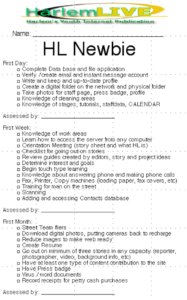 At HarlemLIVE, embarking on the journey as a new member involved much more than just filling out an application form. It meant becoming part of a dynamic and passionate community, embracing its culture, and contributing to its vibrancy. To facilitate this integration, each newcomer received a “Newbie” card, acting as a comprehensive guide for their initial period in the program.
The Newbie card outlined a structured approach for the initial days, ensuring a smooth and inclusive start for every individual.
[/vc_column_text][/vc_column_inner][/vc_row_inner]
First Day:
- Familiarize yourself with cleaning areas.
- Take photos for staff page, press badge, and profile.
- Create a digital folder on the network and a physical folder.
- Write and keep an up-to-date profile.Create email and instant message account.
- Complete database and file application.
- Understand the stages, tutorials, staff data, and the HL CALENDAR.
Assessed by: [Name of the Assessor (HL Veteran or Alum generally)]
First Week:
- Ensure you have your Press badge.
- Begin learning touch typing.
- Determine your interests and set goals.
- Review guides created by editors, gather story and project ideas.
- Familiarize yourself with the checklist for going out on stories.
- Attend the Orientation Meeting (understand the story sheet and HarlemLIVE’s mission).
- Learn how to access the server from any computer.
- Understand the work areas.
- Learn phone etiquette for answering and making calls.
- Receive training for ‘man on the street’ interviews.
- Understand how to use the fax, printer, and copy machines (like loading paper and using fax covers).
- Learn scanning techniques.
- Add and access the Contacts database.
Assessed by: [Name of the Assessor]
First Month:
- Download digital photos and ensure cameras are put back to recharge.
- Resize images to make them web-ready.
- Create a resume.
- Participate in at least three stories in any capacity (reporter, photographer, videographer; gather background info, etc).
- Contribute at least one type of content to the site.
- Familiarize yourself with the process of virus checks or other tech necessities.
- Record receipts for petty cash purchases.
Assessed by:</strong id=”storyworkflow”> [Name of the Assessor]
The Story Ticket System at HarlemLIVE
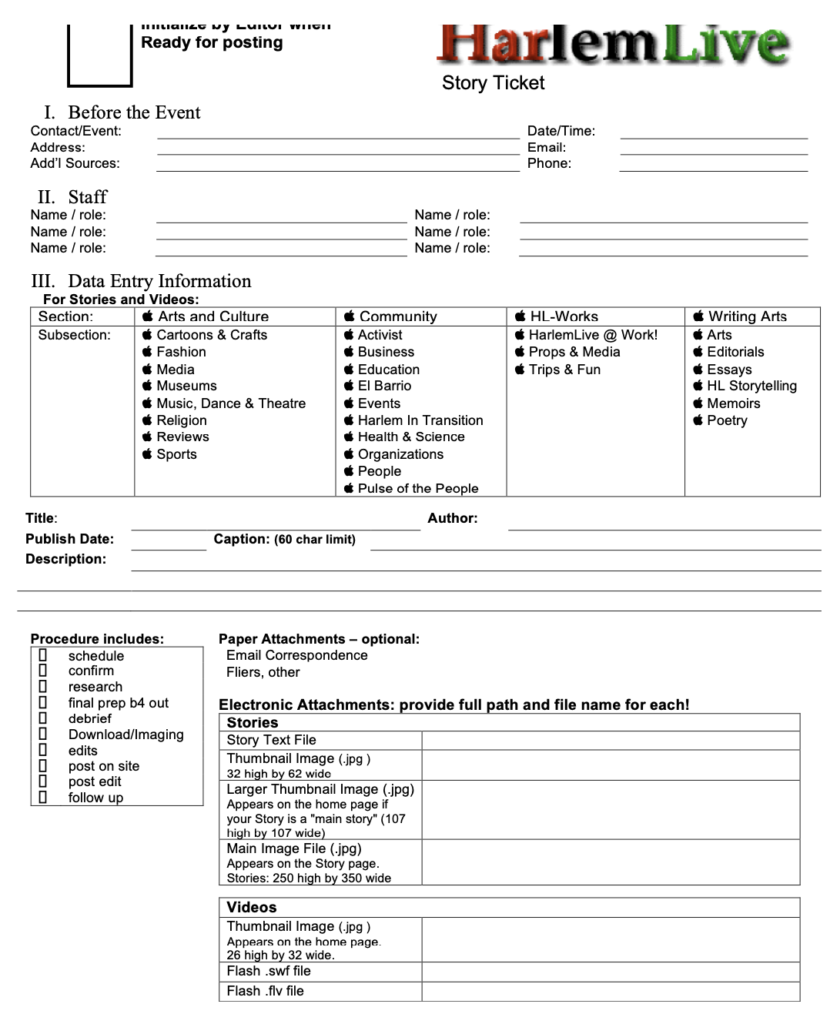
Story Tickets were used to keep track of the stories. This evolved over time.
The “Story Ticket” utilized at HarlemLIVE was an instrumental tool designed to meticulously organize the entire lifecycle of a story, right from its conception to publication. Each Story Ticket served as a comprehensive repository, encapsulating vital information necessary for story development and eventual posting on the website.
Here is an expansion on the content elements of the Story Ticket:
I. Before the Event
- Contact/Event: Details of the event or person being covered by the story.
- Address: Location details of the event.
- Additional Sources: Any supplementary information or sources related to the story.
II. Staff Names / Roles
- Assigned Students and Advising Adults: Identification of the students and mentors involved in the story creation process.
III. Data Entry Information for Stories and Videos
- Data Entry Personnel: Individuals responsible for entering data related to the story or video.
- Section and Subsection: Classification of the story based on its thematic content, dividing it into various sections and subsections such as Arts and Culture, Community, Sports, etc.
Story Details
- Title: The title of the story.
- Publish Date: Planned publication date for the story.
- Description: A brief overview or summary of the story content.
- Author: Attribution to the person or persons responsible for creating the story.
- Caption: A concise caption accompanying the story (limited to 60 characters).
Procedure
- Procedure Steps: Detailed steps outlining the process to follow, including confirming schedules, conducting research, final preparations before going out for coverage, post-interview debrief, download, imaging edits, site posting, editing follow-ups, etc.
Attachments
- Paper Attachments: Optional physical documents related to the story, such as emails, fliers, or other print materials.
- Electronic Attachments: Full paths and filenames of electronic files associated with the story, including text files, images (thumbnails, larger thumbnails, and main images), flash files for videos, etc.
This detailed breakdown within the Story Ticket ensured that all necessary information, tasks, and resources required for the successful creation and publication of a story were methodically recorded and managed, contributing to an organized and efficient workflow for the HarlemLIVE team.
Our Organization System
We used a visible wall-mounted system of five ‘pockets’ to manage the progress of stories:
- Potential Stories: This folder contained initial ideas and upcoming events that were not yet assigned.
- Scheduled Stories: This held stories with arranged interviews and preliminary student assignments.
- Reported Stories / Stories in Editing Process: Here were stories that had completed reporting and were undergoing editing.
- Ready for Publication: Stories that were edited and finalized were kept here, ready for website upload.
- Stories to be Archived: Completed stories that were no longer current were moved here for record-keeping.
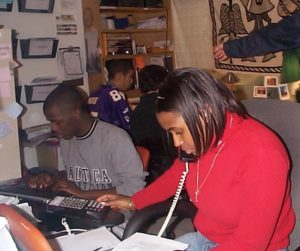
You can see some of the wall pockets we used to track progress of stories
Balancing Old and New: While we tried digital tracking systems, we found that a physical, hands-on method was sometimes more effective and easy to understand at a glance for both team members and visitors.
Personal Spaces: We also provided individual mailboxes for volunteers, giving them a personal space to keep their notes and documents organized.
This straightforward system allowed for effective tracking and management of stories, ensuring that each one moved smoothly through the process from idea to publication.
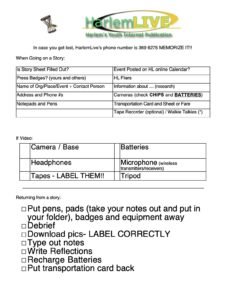
HarlemLIVE On-the-Go: The Essential Checklist
At HarlemLIVE, we believed in preparation. Before our reporters ventured out into the vibrant streets of Harlem or any other location, they were equipped with a checklist that ensured they were well-prepared.
When Going on a Story:
- Is Story Ticket (Sheet) Filled Out?
- Event Posted on HL online Calendar?
- Press Badges? (yours and others)
- HL Fliers
- Name of Org/Place/Event + Contact Person
- Information about …. (research)
- Address and Phone #s
- Cameras (check CHIPS and BATTERIES)
- Notepads and Pens
- Transportation Card and Sheet or Fare
- Tape Recorder (optional) / Walkie Talkies (*)
- Camera / Base / Tripod (optional)
- Batteries
- Headphones
- Microphone (wireless transmitters/receivers)
- Tapes – LABEL THEM!!
Returning from a story:
-
- Put pens, pads (take your notes out and put in your folder), badges and equipment away
- Debrief
- Download pics – LABEL CORRECTLY
- Type out notes / Write Reflections
- Recharge Batteries
- Put transportation card back
Empowerment Through Press Badges at HarlemLIVE
At HarlemLIVE, the press badges were a vital tool for empowerment and learning, especially for newcomers. These badges, printed four to an 8½” x 11″ card stock, were laminated for durability and separated, each with a hole punched at the top for a chain or colored lanyard. When worn around the neck, they signaled a professional approach and intention.
These badges served as more than just identification; they were symbols of trust and credibility. They informed interviewees that conversations were intended for publication, backed by the First Amendment rights of the U.S. Constitution. This aspect was crucial in opening doors to new opportunities and experiences for the students.
The badges granted access to spaces and individuals that might have been out of reach otherwise, playing a key role in the students’ journalistic empowerment. Through these badges, students interviewed influential figures and covered significant events, like celebrity appearances and critical community incidents, with newfound confidence and authority.
In essence, these press badges were not just pieces of plastic and lamination; they represented a transformation in the students’ lives, providing them with the tools and confidence to explore and report on their world.
The Heartbeat of Harlem: Pulse of the People
The hustle and bustle of Central Park became a regular backdrop for HarlemLIVE’s “Pulse of the People” (POP) interviews. More than just a reporting exercise, these street interviews became a transformative rite of passage for many of our students. From rookies learning the ropes to seasoned members guiding the way, the collaborative spirit of HarlemLIVE shone brightly during these excursions.
The First Taste of Journalism
Walking up to strangers and initiating conversations wasn’t everyone’s cup of tea, but it was an essential HarlemLIVE experience. With minimal training, we’d push our new members straight into the deep end. Yet, it wasn’t about throwing them under the bus; it was about teaching them to swim, to find their voice, and to shine.
Rite of Passage
The first POP interview was more than just an assignment; it was a transformative moment. The process was direct: “What news topics pique your interest?” After a newbie’s response, we’d transition to role-playing. How to initiate an interview, handle challenging respondents, and ensure the essence of the message was captured were all part of the drill. If the prospect of approaching strangers was too daunting for some, they’d start as photographers, capturing the essence of HarlemLIVE’s fieldwork through their lenses. HarlemLIVE was not just about journalism; it was about empowerment. It was about making sure each student knew their voice had value and teaching them to express themselves fearlessly. (See Creating Youth Journalists for more detailed instructions).
Student Voices: Growth and Transformation
Tameeka Mitchem reflects: “HarlemLIVE opened me up socially. … It made me more aware of my ability to go out and get the things I want.”
Ena with actress, activist, writer Ruby Dee
And Ena Johnson, who encountered HarlemLIVE as a novice high schooler, adds: “HarlemLIVE had a tremendous impact on my life outlook and journey to self-actualization… This built in me a confidence I carried into adulthood.”
In this video, witnessed Stanley Antoine finishing up his very first attempt at doing a person-on-the-street interview.
Staying Connected: Choosing the Right Digital Communication Platform
I am text block. Click edit button to change this text. Lorem ipsum dolor sit amet, consectetur adipiscing elit. Ut elit tellus, luctus nec ullamcorper mattis, pulvinar dapibus leo.
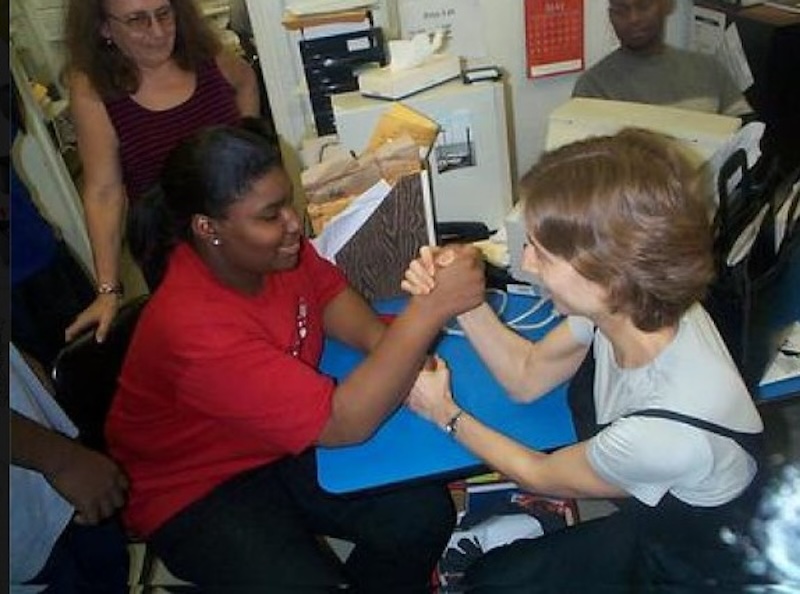
HarlemLIVE EIC Tameeka Mitchem and Playing 2 Win director, Mara Rose
A Perfect Partnership: HarlemLIVE Editor in Chief, Tameeka Mitchem, and Playing 2 Win Director, Mara Rose, engage in a friendly arm wrestling match
[/vc_column_text][/vc_column][/vc_row]
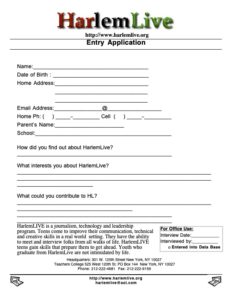 Starting the Journey: The HarlemLIVE Application Process
HarlemLIVE’s application process was the initial step for teenagers interested in journalism, technology, and leadership, serving as the gateway to this transformative program. Chapter 8 in the book, along with other parts of this blog, not only details how HarlemLIVE functioned but also serves as a blueprint for others looking to replicate similar programs.
Application Form Details :
- Personal Information: The form required basic personal details such as the applicant’s name, date of birth, home address, email address, and phone numbers. This was essential for maintaining a direct and personal connection with each applicant.
- Parental and School Information: It asked for the applicant’s parent’s name and the school they attended, ensuring a comprehensive understanding of the applicant’s background.
- Engagement Questions: The application inquired about how the applicant learned about HarlemLIVE, their specific interests in the program, and what contributions they felt they could make. These questions aimed to assess the applicant’s enthusiasm, motivation, and potential role within HarlemLIVE.
- Program Overview: The form also provided an overview of HarlemLIVE, emphasizing its focus on journalism, technology, and leadership skills in a real-world setting.
Unique Intake/Interview Process:
- A notable aspect of HarlemLIVE’s application process was that a veteran HarlemLIVE teen or alum usually conducted the intake and interview. This practice underscored the program’s commitment to being run by teens from the start, fostering a sense of ownership and peer-to-peer learning among participants.
Location and Contact Information (Historical):
- The application listed the headquarters of HarlemLIVE in New York, along with contact details including phone and fax numbers, and an email address.
Purpose and Legacy:
- The application process was a critical part of the HarlemLIVE journey. While the program operated from 1996 to 2010, its legacy continues to inspire and guide new initiatives. By documenting this process, the blog aims to provide a template for those wishing to establish similar programs, highlighting the importance of a well-structured application process in laying the foundation for a successful and impactful youth program in journalism and technology.
Through this historical overview and practical guide, readers can gain insights into the effective methods used by HarlemLIVE and apply these principles to develop their own youth-focused initiatives.
First Steps to Success: The HarlemLIVE Newbie Card
At HarlemLIVE, embarking on the journey as a new member involved much more than just filling out an application form. It meant becoming part of a dynamic and passionate community, embracing its culture, and contributing to its vibrancy. To facilitate this integration, each newcomer received a “Newbie” card, acting as a comprehensive guide for their initial period in the program.The Newbie card outlined a structured approach for the initial days, ensuring a smooth and inclusive start for every individual.
First Day:
- Familiarize yourself with cleaning areas.
- Take photos for staff page, press badge, and profile.
- Create a digital folder on the network and a physical folder.
- Write and keep an up-to-date profile.Create email and instant message account.
- Complete database and file application.
- Understand the stages, tutorials, staff data, and the HL CALENDAR.
Assessed by: [Name of the Assessor (HL Veteran or Alum generally)]
First Week:
- Ensure you have your Press badge.
- Begin learning touch typing.
- Determine your interests and set goals.
- Review guides created by editors, gather story and project ideas.
- Familiarize yourself with the checklist for going out on stories.
- Attend the Orientation Meeting (understand the story sheet and HarlemLIVE’s mission).
- Learn how to access the server from any computer.
- Understand the work areas.
- Learn phone etiquette for answering and making calls.
- Receive training for ‘man on the street’ interviews.
- Understand how to use the fax, printer, and copy machines (like loading paper and using fax covers).
- Learn scanning techniques.
- Add and access the Contacts database.
Assessed by: [Name of the Assessor]
First Month:
- Download digital photos and ensure cameras are put back to recharge.
- Resize images to make them web-ready.
- Create a resume.
- Participate in at least three stories in any capacity (reporter, photographer, videographer; gather background info, etc).
- Contribute at least one type of content to the site.
- Familiarize yourself with the process of virus checks or other tech necessities.
- Record receipts for petty cash purchases.
Assessed by:</strong id=”storyworkflow”> [Name of the Assessor]
The Story Ticket System at HarlemLIVE
Story Tickets were used to keep track of the stories. This evolved over time.
The “Story Ticket” utilized at HarlemLIVE was an instrumental tool designed to meticulously organize the entire lifecycle of a story, right from its conception to publication. Each Story Ticket served as a comprehensive repository, encapsulating vital information necessary for story development and eventual posting on the website.
Here is an expansion on the content elements of the Story Ticket:
I. Before the Event
- Contact/Event: Details of the event or person being covered by the story.
- Address: Location details of the event.
- Additional Sources: Any supplementary information or sources related to the story.
II. Staff Names / Roles
- Assigned Students and Advising Adults: Identification of the students and mentors involved in the story creation process.
III. Data Entry Information for Stories and Videos
- Data Entry Personnel: Individuals responsible for entering data related to the story or video.
- Section and Subsection: Classification of the story based on its thematic content, dividing it into various sections and subsections such as Arts and Culture, Community, Sports, etc.
Story Details
- Title: The title of the story.
- Publish Date: Planned publication date for the story.
- Description: A brief overview or summary of the story content.
- Author: Attribution to the person or persons responsible for creating the story.
- Caption: A concise caption accompanying the story (limited to 60 characters).
Procedure
- Procedure Steps: Detailed steps outlining the process to follow, including confirming schedules, conducting research, final preparations before going out for coverage, post-interview debrief, download, imaging edits, site posting, editing follow-ups, etc.
Attachments
- Paper Attachments: Optional physical documents related to the story, such as emails, fliers, or other print materials.
- Electronic Attachments: Full paths and filenames of electronic files associated with the story, including text files, images (thumbnails, larger thumbnails, and main images), flash files for videos, etc.
This detailed breakdown within the Story Ticket ensured that all necessary information, tasks, and resources required for the successful creation and publication of a story were methodically recorded and managed, contributing to an organized and efficient workflow for the HarlemLIVE team.
Our Organization System
We used a visible wall-mounted system of five ‘pockets’ to manage the progress of stories:
- Potential Stories: This folder contained initial ideas and upcoming events that were not yet assigned.
- Scheduled Stories: This held stories with arranged interviews and preliminary student assignments.
- Reported Stories / Stories in Editing Process: Here were stories that had completed reporting and were undergoing editing.
- Ready for Publication: Stories that were edited and finalized were kept here, ready for website upload.
- Stories to be Archived: Completed stories that were no longer current were moved here for record-keeping.
You can see some of the wall pockets we used to track progress of stories
Balancing Old and New: While we tried digital tracking systems, we found that a physical, hands-on method was sometimes more effective and easy to understand at a glance for both team members and visitors.
Personal Spaces: We also provided individual mailboxes for volunteers, giving them a personal space to keep their notes and documents organized.
This straightforward system allowed for effective tracking and management of stories, ensuring that each one moved smoothly through the process from idea to publication.
HarlemLIVE On-the-Go: The Essential Checklist
At HarlemLIVE, we believed in preparation. Before our reporters ventured out into the vibrant streets of Harlem or any other location, they were equipped with a checklist that ensured they were well-prepared.
When Going on a Story:
- Is Story Ticket (Sheet) Filled Out?
- Event Posted on HL online Calendar?
- Press Badges? (yours and others)
- HL Fliers
- Name of Org/Place/Event + Contact Person
- Information about …. (research)
- Address and Phone #s
- Cameras (check CHIPS and BATTERIES)
- Notepads and Pens
- Transportation Card and Sheet or Fare
- Tape Recorder (optional) / Walkie Talkies (*)
- Camera / Base / Tripod (optional)
- Batteries
- Headphones
- Microphone (wireless transmitters/receivers)
- Tapes – LABEL THEM!!
Returning from a story:
-
- Put pens, pads (take your notes out and put in your folder), badges and equipment away
- Debrief
- Download pics – LABEL CORRECTLY
- Type out notes / Write Reflections
- Recharge Batteries
- Put transportation card back
Empowerment Through Press Badges at HarlemLIVE
At HarlemLIVE, the press badges were a vital tool for empowerment and learning, especially for newcomers. These badges, printed four to an 8½” x 11″ card stock, were laminated for durability and separated, each with a hole punched at the top for a chain or colored lanyard. When worn around the neck, they signaled a professional approach and intention.
These badges served as more than just identification; they were symbols of trust and credibility. They informed interviewees that conversations were intended for publication, backed by the First Amendment rights of the U.S. Constitution. This aspect was crucial in opening doors to new opportunities and experiences for the students.
The badges granted access to spaces and individuals that might have been out of reach otherwise, playing a key role in the students’ journalistic empowerment. Through these badges, students interviewed influential figures and covered significant events, like celebrity appearances and critical community incidents, with newfound confidence and authority.
In essence, these press badges were not just pieces of plastic and lamination; they represented a transformation in the students’ lives, providing them with the tools and confidence to explore and report on their world.
The Heartbeat of Harlem: Pulse of the People
The hustle and bustle of Central Park became a regular backdrop for HarlemLIVE’s “Pulse of the People” (POP) interviews. More than just a reporting exercise, these street interviews became a transformative rite of passage for many of our students. From rookies learning the ropes to seasoned members guiding the way, the collaborative spirit of HarlemLIVE shone brightly during these excursions.
The First Taste of Journalism
Walking up to strangers and initiating conversations wasn’t everyone’s cup of tea, but it was an essential HarlemLIVE experience. With minimal training, we’d push our new members straight into the deep end. Yet, it wasn’t about throwing them under the bus; it was about teaching them to swim, to find their voice, and to shine.
Rite of Passage
The first POP interview was more than just an assignment; it was a transformative moment. The process was direct: “What news topics pique your interest?” After a newbie’s response, we’d transition to role-playing. How to initiate an interview, handle challenging respondents, and ensure the essence of the message was captured were all part of the drill. If the prospect of approaching strangers was too daunting for some, they’d start as photographers, capturing the essence of HarlemLIVE’s fieldwork through their lenses. HarlemLIVE was not just about journalism; it was about empowerment. It was about making sure each student knew their voice had value and teaching them to express themselves fearlessly. (See Creating Youth Journalists for more detailed instructions).
Student Voices: Growth and Transformation
Tameeka Mitchem reflects: “HarlemLIVE opened me up socially. … It made me more aware of my ability to go out and get the things I want.”
Ena with actress, activist, writer Ruby Dee
And Ena Johnson, who encountered HarlemLIVE as a novice high schooler, adds: “HarlemLIVE had a tremendous impact on my life outlook and journey to self-actualization… This built in me a confidence I carried into adulthood.”
In this video, witnessed Stanley Antoine finishing up his very first attempt at doing a person-on-the-street interview.
Staying Connected: Choosing the Right Digital Communication Platform
I am text block. Click edit button to change this text. Lorem ipsum dolor sit amet, consectetur adipiscing elit. Ut elit tellus, luctus nec ullamcorper mattis, pulvinar dapibus leo.